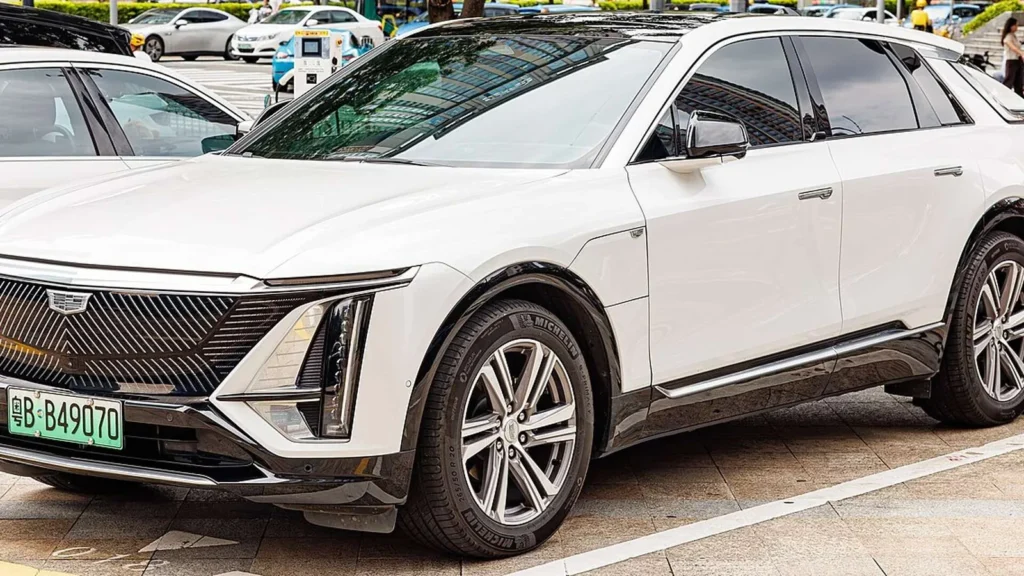
WASHINGTON, DC — General Motors has recalled 67,380 electric vehicles after telling federal regulators that a software defect in a brake system control module can lead to a loss of braking under certain driving conditions. The recall is especially notable for Cadillac Lyriq owners, because it is the second brake-control software action involving that model in a little more than two years.
The filing, identified as NHTSA campaign 26V717 and GM recall number N262570900, covers 2023 through 2027 Lyriq models, 2025 through 2026 Celestiq models, 2026 through 2027 Vistiq models and 2024 through 2027 Chevrolet Blazer EVs. NHTSA says the defect affects the antilock, traction control and electronic limited slip control module, and warns that a loss of braking can raise the risk of a crash.
What GM says the new software defect can do to braking
GM says the fix will be a software update offered free of charge, either over the air or at a dealership. Owner notification letters are expected to go out on Dec. 14, 2026, according to the recall filing.
KARE 11 reported, citing the recall notice, that the problem appears at low speeds and can allow the vehicle to roll forward. The station also reported that GM is aware of 20 incidents, including two that involved minor injuries. Those figures were not independently confirmed in the federal filing available here, but they were included in the outlet’s account of the notice.
The new recall is broad enough to reach multiple Cadillac and Chevrolet EV lines, but it is also centered on one key safety function: whether the software properly manages braking when drivers expect the vehicle to stop or hold position.
How the Lyriq brake issue first drew NHTSA’s attention
The Cadillac Lyriq had already drawn federal scrutiny before this latest recall. On April 11, 2024, NHTSA opened preliminary evaluation PE24011 into the vehicle’s electronic brake module after complaints involving 3,322 model-year 2023 Lyriqs.
GM told the agency that an internal spindle in the module could fracture during an ABS event. When that happens, the company said, the vehicle could lose brake assist, display a speed limit and experience a partial loss of ABS function. Owners reported a hard brake pedal and a brake system failure message before the issue became more obvious.
GM also produced an over-the-air update that cycles the brake booster at every key cycle and turns on a warning lamp if the spindle breaks. That update was not filed as a recall at the time, which meant it did not carry the same formal recall process or owner-letter requirements.
The 2024 Lyriq recall and the software logic behind it
Four months after the preliminary evaluation began, GM filed a formal recall of Lyriq vehicles. Recall 24V-589, submitted on Aug. 8, 2024, covered 21,469 all-wheel-drive 2023 and 2024 Lyriqs.
In that case, GM said the ABS could activate falsely on dry pavement below 25 mph. After a particular sequence of wheel movements, the system could continue releasing service-brake pressure. The company said the root cause was software in the electronic brake control module.
GM estimated that about 1% of the recalled vehicles had the defect and said it knew of two minor accidents. That history helps explain why this latest recall is drawing attention: the same general brake-control area has now produced repeated software actions across multiple model years.
NHTSA’s brake module probe grew from 3,322 vehicles to more than 1.16 million
On Aug. 21, 2026, NHTSA escalated its inquiry from preliminary evaluation to engineering analysis EA26006. At the same time, the agency expanded the estimated population under review from 3,322 vehicles to 1,164,820.
The expanded probe now includes 2023 through 2026 GM models such as the Lyriq, Blazer EV and Celestiq, along with the Equinox EV, Traverse, Colorado, Canyon, Acadia, Enclave, Envision and Optiq. Honda is also listed as an affected manufacturer in the agency’s summary.
NHTSA says it has received 745 field reports and is looking at 22 crashes or fires, five incidents with injuries, six injuries total and no fatalities. The scale of the investigation shows that the brake-module concern is no longer limited to one luxury EV line.
Why a recall is different from a software patch outside recall status
A recall carries legal obligations that a voluntary software update does not. Under federal law, manufacturers must repair recalled vehicles sold within the past 15 years at no charge, and the VINs are added to NHTSA’s searchable recall database. Recall notices also trigger owner letters.
By contrast, the earlier over-the-air update GM issued for the Lyriq spindle issue was not filed as a recall. That distinction matters to owners because it can affect whether a repair is formally tracked, whether a vehicle is searchable in the public recall system, and whether the repair is clearly covered as a recall remedy.
Owners can check a vehicle identification number on NHTSA’s recall page. The 26V717 VINs became searchable on Oct. 29, and Cadillac owners can call 1-800-333-4223 while Chevrolet owners can call 1-800-222-1020 for more information.
What remains unclear about the braking defect and the next steps
GM’s latest filing says braking can be lost in certain driving conditions, but the public record reviewed so far does not yet spell out whether the new problem works the same way as the 2024 Lyriq software defect or whether it has a different mechanism. The company’s root-cause explanation in the full Part 573 filing would provide more detail.
The NHTSA probe and the new recall are related in the sense that both involve brake-control software, but they are not identical. NHTSA’s engineering analysis centers on the spindle fractures GM identified in the Lyriq brake module, while the new recall reaches a wider group of vehicles.
The Vistiq is included in the recall even though it is not named in the current engineering analysis. That means the software exposure is broader than the hardware-focused scrutiny, and the end of EA26006 will determine whether regulators push for another formal recall or leave the spindle issue addressed by the existing patch.

Leave a Reply