
WASHINGTON, DC — The U.S. Department of Agriculture’s Food Safety and Inspection Service has issued a public health alert for frozen, not ready-to-eat meat and poultry products sold online across the country. The warning covers Bami Rolls, Saté Kroketten, and Bitterballen made on three dates in October and labeled with specific lot codes and establishment numbers.
Federal officials said the products contain sesame, and in one case anchovy from Worcestershire sauce, but those allergens were not declared on the packaging. Because sesame and fish can trigger serious reactions in sensitive consumers, FSIS classified the event as a high-risk public health issue.
The agency did not request a recall because the products are no longer being sold. No confirmed allergic reactions have been reported so far, but officials urged anyone who may have eaten the items and feels unwell to seek medical advice.
Which products are covered by the federal alert
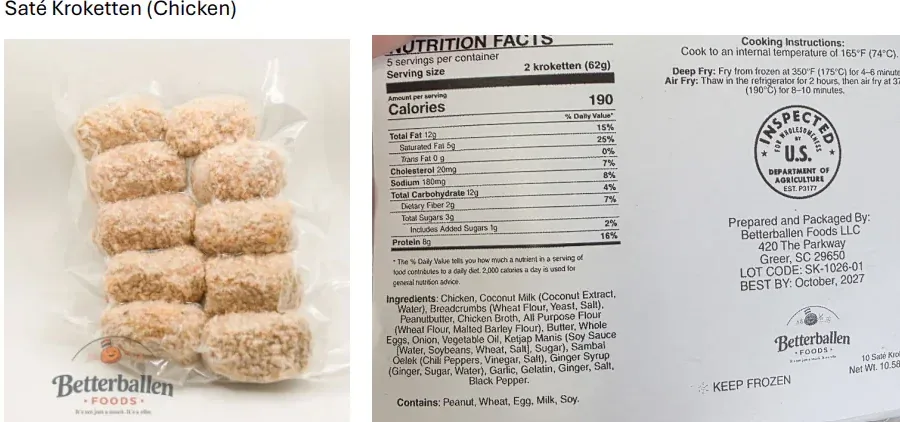
FSIS identified three frozen items in vacuum-packed clear packaging. The 12-piece beef product is labeled Bitterballen and carries lot code BB-1026-01. The 10-piece chicken item is labeled Saté Kroketten with lot code SK-1026-01. The 6-piece pork product is labeled Bami Rolls with lot codes BR-2026-01 and BR-2026-02.
All three products have an Oct. 27 expiration date. They also bear establishment numbers EST. M3177 or EST. P3177 inside the USDA mark of inspection. FSIS said the products were sold online nationwide, which means customers in multiple states may have received them through direct-to-consumer orders.
The agency’s notice is aimed at consumers who may still have the items in their freezers. Anyone with the affected products is being advised not to eat them, especially if there is a known allergy to sesame or fish.
Why FSIS classified the alert as a high-risk health hazard
The USDA said the event falls into a Class I category, which it describes as a high- or medium-risk situation. In the agency’s words, that type of health hazard involves a reasonable probability that using the product could cause serious adverse health consequences or death.
That classification reflects the fact that undeclared allergens can be dangerous even when the food itself is otherwise safe to eat. Sesame is a known allergen, and anchovy is a fish ingredient that may not be obvious to shoppers reading the label on a prepared meat product.
FSIS warned that consumers who are allergic or sensitive to fish or sesame could experience a reaction if they eat the products. The alert is intended to help prevent those exposures before more people are affected.
No recall ordered because the products are no longer on sale
Unlike a formal recall, a public health alert is used when a product may present a risk but is not necessarily still available in commerce. In this case, federal authorities said they stopped short of ordering a withdrawal because the products are no longer for sale.
That does not mean the risk has disappeared. Some consumers may still have the frozen items stored at home after buying them online. FSIS issued the warning so those households can check labels, lot codes, and expiration dates before serving the food.
Officials have not reported any confirmed adverse reactions tied to the products. Even so, people who suspect they have had an allergic response were told to contact a health care provider.
How the mislabeled ingredients create the danger for shoppers
For people with food allergies, the label is often the only warning they get before eating. If a package fails to disclose sesame or fish, a consumer may assume the product is safe when it is not. That is why undeclared allergens are a major focus of federal food safety enforcement.
In this alert, FSIS said the beef item contains Worcestershire sauce with anchovy, while the products also contain sesame that was not listed on the label. Even small amounts can be enough to trigger a reaction in a sensitive person.
Consumers are typically urged to compare the product name, lot code, and establishment number before cooking or serving frozen meat products ordered online. Those details can help determine whether an item falls under a federal warning.
Another recent meat withdrawal involved beef jerky sold in seven states
The public health alert comes after another meat-related action last month, when 946 pounds of beef jerky were withdrawn from sale in seven states. That product was distributed in Illinois, Indiana, Iowa, Michigan, Minnesota, Missouri, and Wisconsin between January and October, according to FSIS officials.
In that case, the agency said the recall involved the unapproved use of another facility’s mark of inspection. The establishment number listed was 1885 inside the USDA mark of inspection. While that earlier action involved a different product and issue, it shows how FSIS continues to monitor meat and poultry items moving through retail channels.
Federal food safety notices often rely on lot codes and inspection marks because they help consumers identify exactly which package is affected. For shoppers, the safest move is to stop using any product that matches an active alert and follow federal guidance.

Leave a Reply