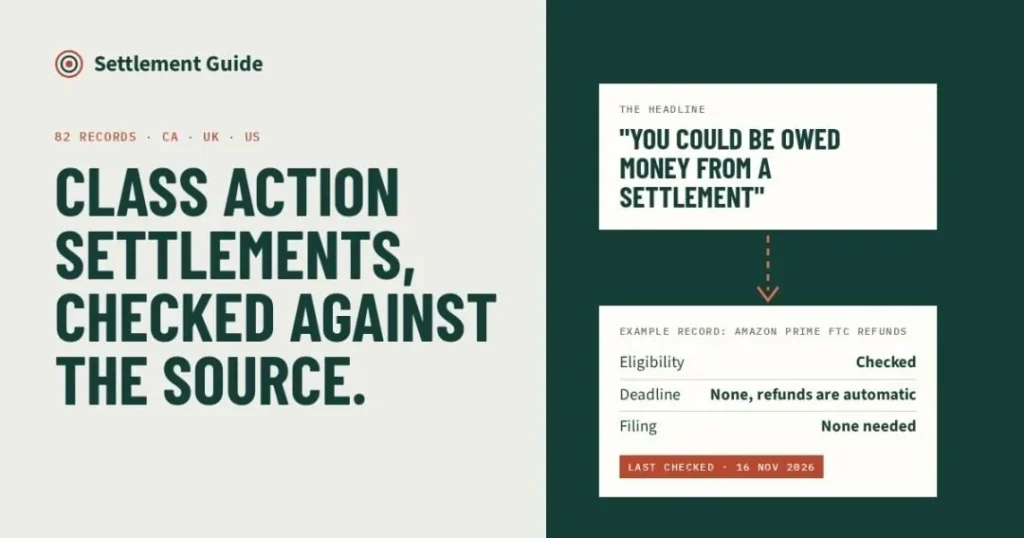



NEW YORK, NY — Settlement Guide says it now tracks 82 class action settlements and regulator refund programs across the United States, Canada and the United Kingdom, with each entry tied back to an official administrator, court or regulator. The New York-based publication says the goal is to help people verify whether they qualify, what documents they need and when a claim window closes before they share personal information.
The site says its records also show when each case was last checked. If a deadline or rule has not been reviewed recently, that is noted on the page so readers can judge how current the information is. Settlement Guide says that approach is meant to cut through headlines that announce money without explaining the actual terms.
U.S. cases make up the largest share of the database
Of the 82 records currently listed, 40 are in the United States, along with 25 in Canada and 17 in the United Kingdom. Settlement Guide says U.S. cases are also available in Spanish, which expands access for readers who want to review the information in that language before deciding whether to file.
The site separates cases that are still open from those where participation has already closed. That distinction matters because settlement pages can look similar at first glance even when the action a reader needs to take is very different. Some cases require a claim, while others are handled automatically or may already be finished.
Settlement Guide says the database is organized so users can browse by topic rather than search through unrelated listings. The categories include flight cancellations, internet, cable and phone outages, and cruise cancellations.
Amazon Prime refunds show how the site points readers to official rules
The Amazon Prime refunds ordered by the U.S. Federal Trade Commission are one example highlighted by the company. According to the FTC, eligible Prime customers do not need to submit a claim. Refunds are paid automatically, and the agency says the total can reach $200.
Settlement Guide says its record for that case links directly to the FTC’s own page and was last checked on Nov. 16, 2026. The FTC says the final round of refunds is expected to begin by April 2027. That kind of timing detail is central to the guide’s format, since people often need to know not only whether money is available but whether they must act at all.
The company says it uses official sources so readers can see the governing rule instead of relying on a summary pulled from a headline or social post. In the Amazon case, that means the agency’s instructions matter more than a generic notice that refunds exist.
Thomas Prommer says settlement headlines often leave out the key decision points
Thomas Prommer, who publishes Settlement Guide, said the site is built to answer the questions that settlement headlines often skip. He said a headline may tell people that money exists, but it usually does not explain whether they qualify or whether any action is required.
Prommer said the purpose is to help people see the official answer before they give information to anyone else. That includes the basic details that can determine whether a person should file a claim, wait for automatic payment or do nothing because the participation period has already ended.
The company’s pitch is that claims information should be treated like a verification exercise, not just a news alert. By tying each record to the original administrator, court or regulator, Settlement Guide says it is trying to reduce confusion around notices that can otherwise be hard to interpret quickly.
How the database is organized and what readers can expect to find
Settlement Guide says each of its 82 records includes the source behind the case, the requirements for participation and the claims deadline or closing date when one exists. The site says it also indicates whether a record has been rechecked recently, giving users a sense of how fresh the information is before they rely on it.
The publication describes itself as an independent reference rather than a law firm or claims service. It says it does not file claims, decide eligibility or promise payouts. Instead, it points readers toward the official bodies that control the terms and the process.
That setup makes the site more of a navigation tool than an advocate. For readers sorting through settlement notices, the practical value is supposed to be speed and clarity: a single place to check where a case stands, what the rules say and whether there is still time to act.
The company says transparency matters before people hand over personal details
Settlement Guide says its broader mission is to make settlement and refund information easier to verify before a person submits details online. The company argues that official-source checking is important because offers that sound attractive can still require specific proof, identity details or a fast response.
The site also frames its work as a response to the volume of settlement news that circulates without enough context. By showing which records are open, which have closed and when each page was last reviewed, Settlement Guide says it gives readers a clearer path to the official instructions.
The company, published by Prommer and based in the United States, says the service is intended for people in the U.S. as well as readers in Canada and the United Kingdom. For American consumers, the main promise is simple: verify the official rules first, then decide whether a claim is worth pursuing.

Leave a Reply