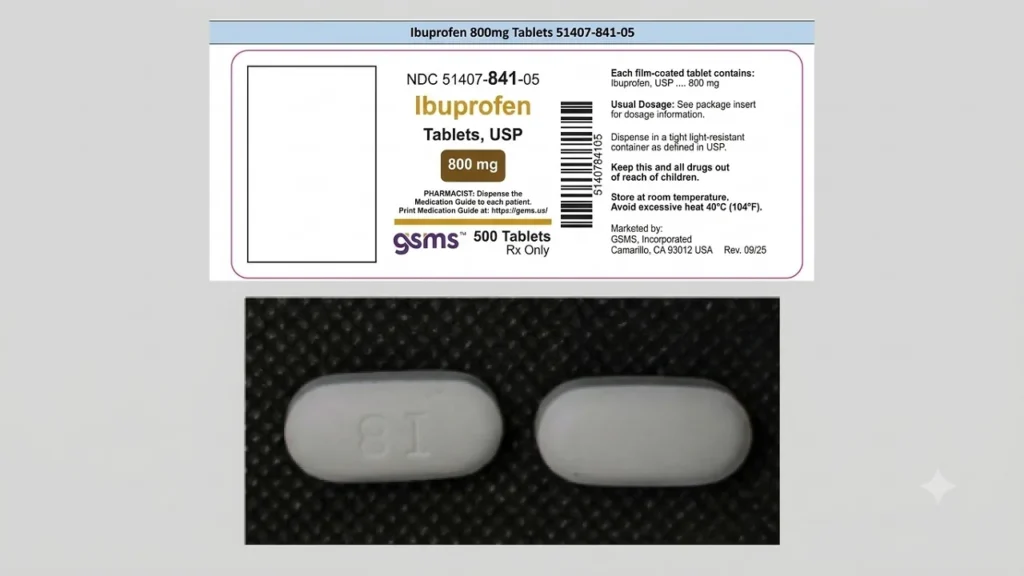



WASHINGTON, DC — The Food and Drug Administration has announced a nationwide recall of ibuprofen 800 mg tablets distributed by Golden State Medical Supply because of possible aluminum particulate contamination. The agency said the affected product could pose a risk if taken as directed or continued over time.
Consumers are being advised to stop using the impacted lot. The concern is not that the tablets will cause a severe emergency in every case, but that aluminum particles in the medication may irritate the stomach and intestines.
Ibuprofen is widely used for pain relief and inflammation, which makes any recall of a higher-strength tablet especially important for patients who may depend on it daily. The FDA’s notice focuses on one specific distribution lot rather than the drug generally.
What the FDA says about the aluminum contamination risk
The FDA said continued use of the recalled ibuprofen tablets may lead to minor irritation and abrasion of the stomach and intestinal lining. That is the main health risk identified in the recall notice.
Aluminum particulate contamination means small foreign particles may be present in the tablets. The agency did not describe the issue as a full product failure, but it did determine the problem was serious enough to justify a nationwide recall.
For consumers, the practical advice is straightforward: do not keep taking the affected product if it matches the recalled lot. People who use prescription-strength ibuprofen should check their bottle carefully and follow the recall instructions from the FDA and distributor.
Why 800 mg ibuprofen recalls matter for regular users
An 800 mg ibuprofen tablet is a high-dose formulation often used when over-the-counter strengths are not enough. That makes a recall more significant for patients who may have been taking the product repeatedly for pain or inflammation.
Even though the FDA described the likely health effect as minor irritation, the warning matters because the stomach and intestines are already areas where ibuprofen can cause problems if used heavily or incorrectly. A contaminated tablet adds another layer of concern.
The recall also underscores why prescription medicines are monitored for physical contamination, not just dosage or labeling errors. Foreign particles can create risks that are separate from the intended action of the drug itself.
What consumers should do with the affected tablets
Anyone who has ibuprofen 800 mg tablets from Golden State Medical Supply should look for the lot tied to the recall and stop using it if their medication matches. The FDA’s guidance is to avoid continued use of the affected product.
Patients should not assume every bottle of ibuprofen 800 mg is part of the recall. The notice is limited to the specific lot named by the agency, so checking the label and packaging is essential before discarding medicine that may still be safe.
If a consumer has already taken some of the tablets, the main issue described by the FDA is irritation or abrasion of the gastrointestinal lining. People concerned about symptoms or what to do next should contact a pharmacist or health care provider.
Golden State Medical Supply's role in the nationwide recall
Golden State Medical Supply distributed the recalled tablets, and the FDA’s action applies across the country. The company is at the center of the recall because it handled the product lot tied to the contamination concern.
Recalls like this are part of the FDA’s routine oversight of prescription drugs and distribution chains. When a product may contain a foreign substance, regulators can move to remove it from circulation before the issue spreads further.
The notice does not suggest a broader problem with all ibuprofen products from the company. Instead, it points to a specific lot and a specific contamination concern, which helps limit the recall to the affected inventory.
How to check pain relievers for recall notices and lot numbers
Medication recalls often depend on details such as the manufacturer, strength, and lot number. That is why patients are urged to compare the information on their bottle or package with the recall notice before deciding what to do.
For prescription pain relievers, keeping the original container can make this process easier. The lot number, strength, and distributor name are the key identifiers that determine whether a product is included in a recall.
In cases involving possible contamination, consumers should take the warning seriously even if no symptoms are present. The FDA’s goal is to remove the impacted medicine before more people are exposed to the affected tablets.

Leave a Reply