
WASHINGTON, DC — The National Highway Traffic Safety Administration is proposing a major rewrite of the federal lighting standard that governs new vehicles, including automated cars built without a steering wheel or pedals. The changes would update rules in FMVSS 108, the long-standing standard for lamps, reflectors and turn signals, so they can better fit vehicles that do not rely on a human driver.
The proposal would do three main things: remove lighting requirements that assume a driver is physically controlling the car, add an optional cyan marker lamp to show when a vehicle is operating without expecting anyone inside to monitor the road, and revise two headlamp rules that apply to all vehicles. NHTSA is scheduled to publish the notice of proposed rulemaking in the Federal Register on Oct. 26, and public comments would be accepted for 30 days under docket NHTSA-2026-1519.
Why FMVSS 108 does not fit steering-wheel-free vehicles
FMVSS 108 was written around the idea that a person is driving. That creates problems for vehicles that have no steering wheel, no pedals and no human operating the controls. Some current rules require a driver to cancel turn signals by returning the wheel to center, use a hand or foot to switch beams, or quickly activate hazard flashers from the driver’s seat.
NHTSA says those requirements do not make sense for automated vehicles that lack manual controls. Under the proposal, those duties would apply only to vehicles that actually have manual driving equipment. The hardware would not disappear, though. The automated driving system would still control the turn signals and beam switching, and the agency would replace the familiar turn-signal and high-beam indicators with a lamp-failure telltale visible from every seating position.
The agency says manufacturers might otherwise keep seeking exemptions one by one. Rewriting the standard, NHTSA argues, would be a cleaner way to address a growing category of vehicles rather than handling each design as a separate exception.
The proposed cyan lamp is meant to signal an attentive-driving free zone
NHTSA’s new lamp concept is designed to tell other road users that a vehicle is “operating without the expectation that an occupant is monitoring the roadway.” That makes it a signal for Level 3 and higher automated driving, not a light for ordinary driver-assistance systems.
The proposed color would be cyan, the blue-green shade defined in SAE J578. The agency says amber, red and white already carry established meanings, so cyan would fill a new role. The lamp could appear as one or two lights on the front, both sides and rear, for a total of four to eight lamps, each mounted at least 15 inches above the ground. It would stay steady when illuminated rather than flashing, though NHTSA is asking whether some flashing use might be useful in certain situations.
Brightness limits would vary depending on whether the headlights are on. The lamps also could not share a housing optically with other lights, which would make the signal visually distinct on the vehicle.
Mercedes validation data helped shape the federal lamp proposal
NHTSA says it built the cyan-lamp specification from SAE J3134, but it did not adopt that standard exactly. The federal version departs on photometry, the number of lamps and whether the signal can be combined with other lighting elements.
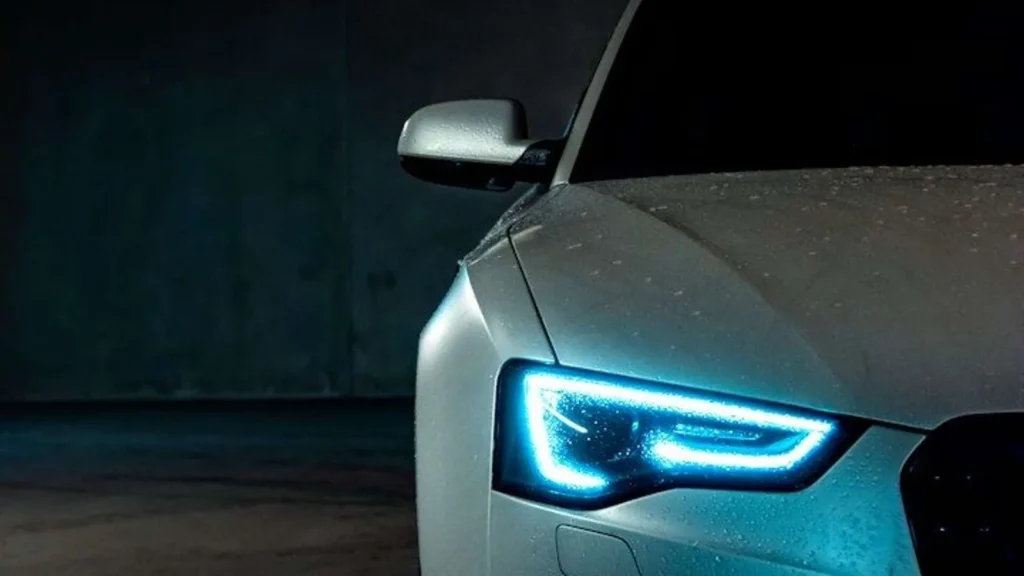
The agency points to Mercedes-Benz’s two-year on-road validation in California, which involved five vehicles, as part of the evidence base for the design. That testing is one reason turquoise lighting on Mercedes Drive Pilot vehicles may look familiar to drivers who have seen automated-car demonstrations or prototypes.
The lamp would be optional, not mandatory. NHTSA says it does not yet have enough evidence to require every automated vehicle to use the signal. At the same time, the proposal would ban the lamp on vehicles without automated driving capability. If finalized, an ordinary car fitted with cyan accent lighting could fall out of compliance with federal rules.
Federal rule could override some state color laws but leave police blue untouched
California already permits these lamps under Vehicle Code sections 25950 and 38750, which refer to the SAE standard. NHTSA says its final rule would likely preempt those state provisions where the federal version differs from SAE J3134. The agency also expects the rule to override other state color laws that would bar a compliant cyan lamp.
At the same time, NHTSA says laws reserving blue for police vehicles should not be affected because cyan is a different color. The agency is also taking a tentative position that the rule would not broadly block state lawsuits, although some claims tied to how a fitted marker lamp performed could be impliedly preempted.
That liability question could matter if the rule is finalized and cyan lamps become part of the visual language of automated driving. NHTSA is effectively inviting comments not just on design, but on how the federal standard would interact with state law and future courtroom disputes.
Headlamp updates would apply to every new vehicle, not just robotaxis
Two other revisions in the proposal would affect all cars. First, integral-beam headlamps, including most modern LED units, would be tested at their marked design voltage instead of the 12.8 volts used since the sealed-beam era. Test results would also be expressed in watts. NHTSA says that change better reflects how LED systems actually work because their driver electronics do not behave like older lamp designs.
Second, the rule requiring a low beam to sit above a high beam in vertical headlamp layouts would be removed. The agency says mounting-height limits would remain in place, but designers would have more freedom in front-end styling. Those revisions are separate from the automated-vehicle changes, yet they are part of the same broader update to FMVSS 108.
For now, nothing changes for owners. This is still a proposal, and NHTSA has not yet calculated final costs or benefits. The agency’s broader message is simple: automated vehicles need lighting rules that match how they actually operate, while ordinary cars still need to stay within the federal standard.

Leave a Reply