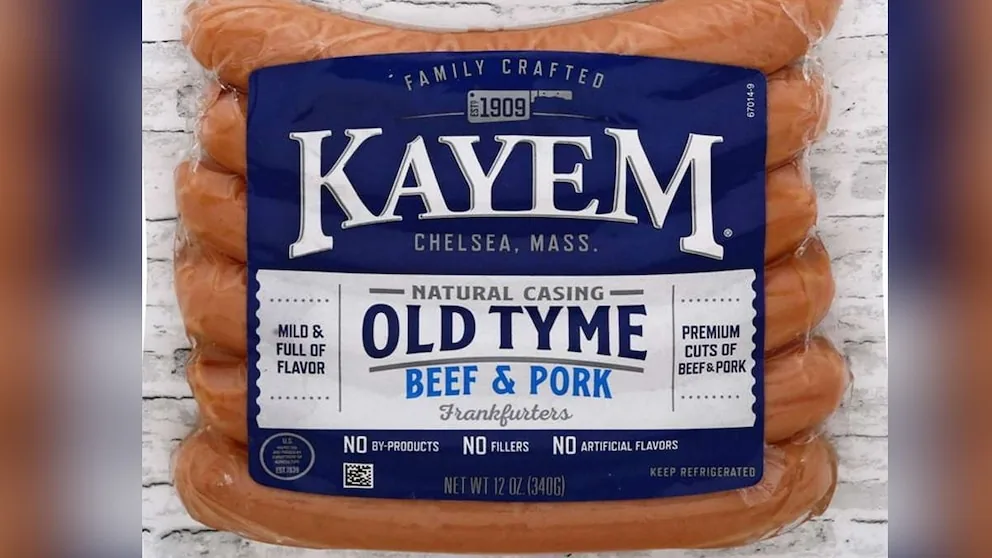
WASHINGTON, DC — Nearly 1.6 million pounds of ready-to-eat cooked meat and poultry products are being recalled nationwide after a storage temperature problem at a Massachusetts company’s warehouse. Kayem Foods, Inc. and the U.S. Department of Agriculture’s Food Safety and Inspection Service announced the voluntary recall after a cooling system malfunction caused temperature deviations at one of the company’s facilities.
The recalled items include bacon, bologna, bratwurst, brisket, chicken sausage, corned beef, frankfurters, hot dogs and kielbasa. Federal officials said the products were shipped across the country and also sent to Hong Kong, making the recall unusually broad in both volume and reach.
How the cooling system failure led to the recall
Kayem Foods said the recall was triggered by a malfunction in a warehouse cooling system that affected how the products were stored. The company said it learned of storage temperature deviations and worked with federal regulators to pull the affected meat from distribution.
In a statement, company president and CEO Matt Monkiewicz said the management team takes responsibility for the problem and has corrected it. He also apologized to consumers and said the company does not intend for a similar failure to happen again.
Food safety experts and the USDA stress that meats must stay properly refrigerated or frozen to remain safe. The agency says refrigeration should be at 40 degrees Fahrenheit or lower, while freezing should be at 0 degrees.
Which products and labels are included in the recall
The USDA said the recalled items were produced between about March 31 and Oct. 7. Kayem Foods said the products were stored and shipped between June 7 and Oct. 14, placing the affected goods into circulation over several months.
Consumers should check labels for the establishment numbers “EST. M/P 7839,” “EST. P 20935A” and “EST. M 9520,” which appear inside the USDA inspection mark. Those identifiers help shoppers match packages in their refrigerators and freezers with the recalled lots.
A full list of the affected products is posted on the USDA’s website. Because the recall covers multiple meat and poultry items, regulators are urging customers to inspect packages carefully before eating or serving them.
What federal regulators say consumers should do now
The USDA and Kayem Foods say no illnesses have been reported so far. Even so, anyone who has the recalled products should not eat them. The safest step is to discard them or follow disposal instructions provided by retailers or wholesale distributors.
For people worried about possible illness after eating any of the recalled foods, the USDA recommends contacting a healthcare provider. The agency is also offering guidance through its toll-free meat and poultry hotline for questions about the recall.
Kayem Foods said it is reaching out to wholesale and retail customers to explain how to handle the products and dispose of them properly. That outreach is intended to help remove the affected items from store shelves and other distribution channels as quickly as possible.
Why proper cold storage matters for ready-to-eat meats
Ready-to-eat meat products are designed to be handled safely when cold storage stays within recommended limits. Once temperatures rise above those levels for too long, the risk of foodborne illness can increase even if the food still looks and smells normal.
The USDA encourages consumers to use its cold storage chart as a reference and to keep meat either refrigerated at 40 degrees Fahrenheit or below or frozen at 0 degrees. Those guidelines are especially important for products that are already cooked and ready for immediate consumption.
Because the recalled foods were distributed over time, some packages may still be sitting in home refrigerators or freezers. Federal officials say the labels and establishment numbers are the key tools for identifying whether a package belongs in the recall.
How consumers can reach Kayem Foods and the USDA
Kayem Foods is directing customers with questions to its consumer service line at 800-426-6100 or by email at [email protected]. The company said it is handling the recall response and responding to customer inquiries as the process continues.
Consumers who want food safety guidance can also contact the USDA’s meat and poultry hotline at 888-MPHotline, or 888-674-6854, or email [email protected]. Those channels are meant for questions about the recalled products and how to respond if a package matches the affected labels.
The recall is one of the larger meat and poultry removals in recent memory because of its size, range of products and nationwide distribution. For now, federal officials say the main message is simple: check labels, avoid eating the affected foods and discard anything tied to the recall.

Leave a Reply