WASHINGTON, DC — The Food and Drug Administration has elevated a raw milk cheddar cheese recall to its most serious risk category after testing raised concern that the product could contain dangerous strains of E. coli. The Class I designation means the agency believes there is a reasonable chance the cheese could cause serious health problems or death if eaten or handled.
The recall involves Family Farmstead Mild Raw Cheddar sold by Family Farmstead Dairy of Worcester, New York. The company initiated the voluntary recall on Oct. 14, and the FDA classified it as Class I on Nov. 5.
So far, no illnesses have been connected to the cheese. Still, the recall now carries the highest level of concern in the agency’s system, putting it among the products regulators consider most likely to cause harm if they reach consumers.
What cheese is included in the recall
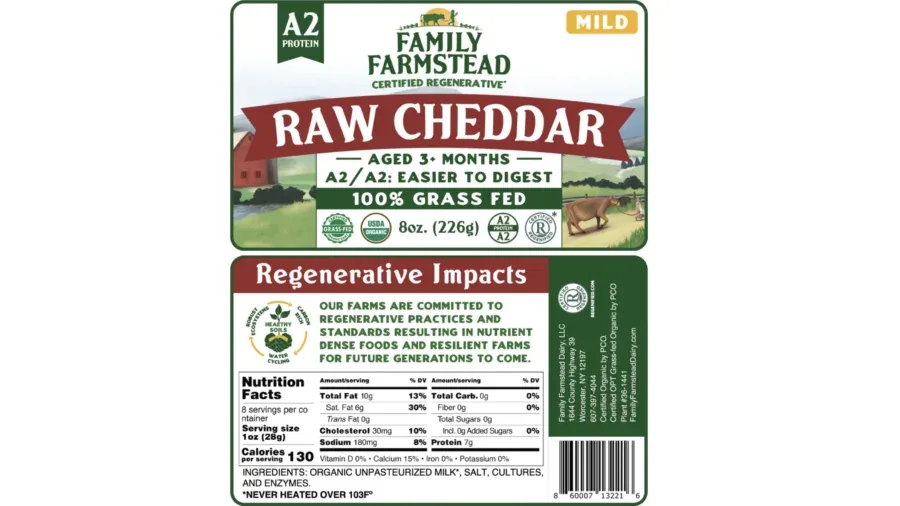
The recalled product is Family Farmstead Mild Raw Cheddar packaged in 8-ounce blocks. It was sold in clear vacuum-sealed plastic and carried a white, red and green label. The label says the cheese was aged for at least three months and made with organic, unpasteurized milk.
Each package has a best-by date of July 22, 2027, and the company lists that same date as the lot code. The UPC number printed on the package is 860007132216. Family Farmstead said no other products from the dairy are included in the recall.
Consumers checking their refrigerators should look for those exact package details before deciding whether a product is affected. The recall is limited to this specific cheddar, not the dairy’s full line of products.
Testing in Maryland found two harmful E. coli strains
The recall was triggered after testing in Maryland detected two strains of Shiga toxin-producing E. coli in samples of the cheese. Family Farmstead identified the strains as E. coli O26:H11 and O45:H2.
The company also said it corrected information related to the bacteria and to the states where the cheese had been distributed. That correction followed the testing results and the recall announcement.
Shiga toxin-producing E. coli can cause serious illness, unlike the many harmless types of E. coli that live in the environment and in the intestines of people and animals. The CDC says these strains are among the ones most likely to lead to significant health problems.
Where the recalled blocks were shipped
The recalled cheese was sent to distributors in Connecticut, Massachusetts, Maryland, New Jersey, New York, Pennsylvania and Virginia. Additional distributors may have moved the product into other states, according to the recall notice.
The FDA enforcement report places the total at 402 pounds, or 67 cases. Each case contained 12 blocks of the 8-ounce cheddar.
That distribution pattern means the product may have reached a broad number of retail locations and customers across the Northeast and Mid-Atlantic. Consumers outside the listed states could still have purchased it if additional distributors relayed it farther afield.
What shoppers should do if they bought it
Family Farmstead is telling customers to throw away the cheese or take it back to the store for a full refund. People should not eat any block that matches the recall details.
The company has also set up a contact number, 607-397-4044, and an email address, [email protected], for questions. Customer service is available from 8:30 a.m. to 5 p.m. Eastern time, Monday through Friday.
Anyone who believes they may have become ill after eating the cheese should seek medical advice. Symptoms linked to these bacteria can include diarrhea, often with bloody stools.
Why public health officials treat this contamination seriously
Most healthy adults recover from E. coli infections within about a week, but some cases can become much more severe. The CDC warns that Shiga toxin-producing strains can cause hemolytic uremic syndrome, a condition that may lead to kidney failure.
Young children and older adults face the greatest risk of developing that complication, and people with weakened immune systems are also more vulnerable. For that reason, a recall tied to these bacteria is treated with extra caution even when no one has reported illness yet.
The FDA’s Class I label reflects that concern. In practical terms, it signals that regulators think the product could pose a serious or even life-threatening hazard if it is consumed.
No illnesses reported as recall remains in effect
Despite the elevated warning, health officials have not linked any illnesses to the cheddar at this time. That means the recall is precautionary, based on testing and product distribution rather than confirmed sickness.
For now, the key public-health message is simple: check the label, avoid eating the recalled blocks, and dispose of or return any matching packages. Because additional distributors may have shipped the cheese beyond the states already listed, consumers are being urged to verify the package details carefully.
The recall remains in place as regulators and the company continue to address the contaminated product and its distribution trail.

Leave a Reply