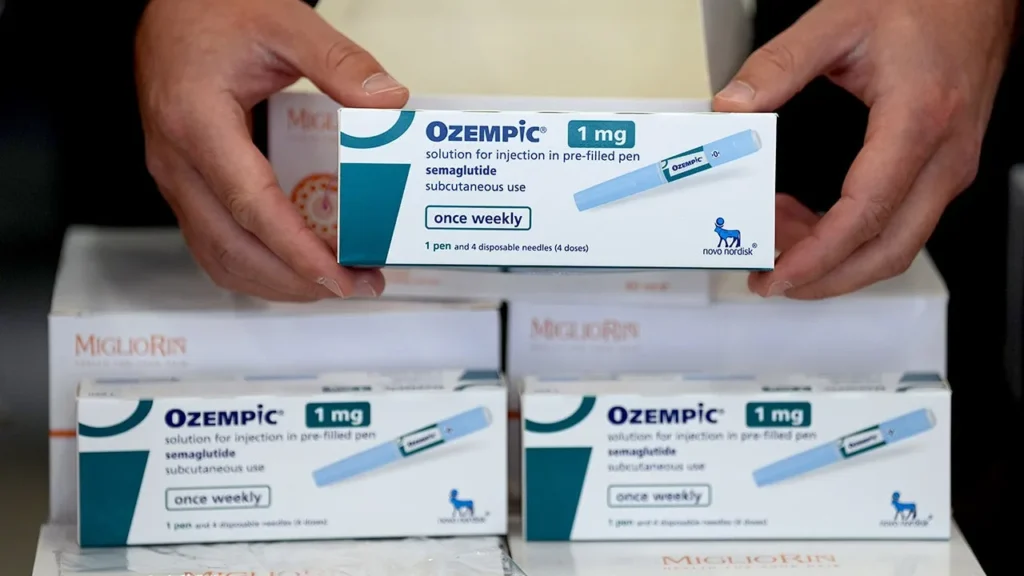



WASHINGTON, DC — The Food and Drug Administration is requiring new warning labels on a group of GLP-1 drugs, including Ozempic and Wegovy, after reviewing evidence of a rare eye condition tied to permanent vision loss. The agency said the side effect, non-arteritic anterior ischemic optic neuropathy, has been reported in patients taking the medicines used to treat obesity, diabetes and other conditions.
FDA scientists began looking into the issue in 2024 after a study raised concerns about semaglutide, the active ingredient in Novo Nordisk’s Ozempic. After reviewing 126 clinical trials involving 134,253 patients, the agency concluded the risk appears small but serious enough to warrant updated labeling across the class of drugs.
What the FDA found in its trial review
The agency’s review compared outcomes across trials and found about six cases of the eye disorder per 100,000 patients taking GLP-1 drugs over one year. That was higher than the rate seen among people taking a placebo or other glucose-lowering medications, where there were fewer than four cases per 100,000 patients.
FDA officials also said patients taking GLP-1 drugs had a roughly 68% higher rate of developing the condition. Even so, the agency stressed that the findings do not prove the medicines cause the vision loss. The review is based on a statistical association, not a confirmed direct link.
Why the eye condition raises concern for patients
Non-arteritic anterior ischemic optic neuropathy happens when blood flow to the optic nerve is reduced. The condition can lead to major vision loss, and in some cases the damage may be permanent. The FDA said the underlying cause is still unclear, even though the disorder has been reported in patients taking all GLP-1 drugs.
The condition is especially concerning because there is no proven treatment that can reverse the injury once it occurs. The agency noted that people over 50 are most often affected, and many wake up with sudden, painless loss of vision in one eye. Symptoms can include blurred vision, distorted color perception and blind spots.
Why it is hard to separate drug risk from patient risk
The FDA said it is difficult to know how much of the risk comes from the drugs themselves because several known risk factors overlap with the populations most likely to receive them. Diabetes, high blood pressure and sleep apnea are all linked to the condition, and they are also common among patients prescribed GLP-1 medications.
That overlap makes the numbers harder to interpret. The agency acknowledged that people taking these drugs may already be more vulnerable to eye problems, which complicates efforts to determine whether the medications are driving the increase or whether other health conditions are contributing.
How often the condition appeared in the reviewed studies
Among roughly 78,000 patients included in the studies the FDA examined, just 10 experienced vision loss. That works out to about 0.01% of participants, underscoring how rare the complication appears to be.
Still, the agency said rare does not mean harmless when the outcome can be severe and lasting. The warning labels are intended to make patients and clinicians more aware of the possibility, especially for people already at higher risk because of age or underlying medical conditions.
What patients should know about symptoms and recovery
The FDA’s warning comes as research continues to examine how often the disorder causes long-term damage. Some studies have found that about 43% of patients with significant vision impairment experience at least some spontaneous improvement. Even so, visual field defects often remain.
That means recovery can be incomplete even when vision partially returns. The new labels are meant to alert users to watch for sudden changes, including blurred vision, color changes or blind spots, and to seek medical care promptly if symptoms appear.

Leave a Reply